There are primarily three methods of indexing:
- Clustered Indexing.
- Non-Clustered or Secondary Indexing.
- Multilevel Indexing.
What is indexing and its types?
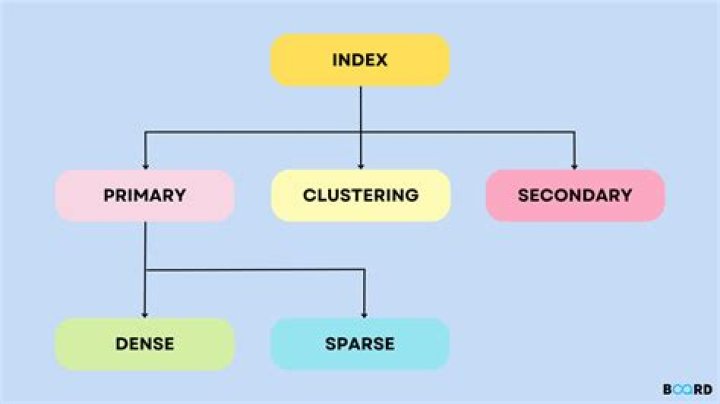
Summary: Indexing is a small table which is consist of two columns. Two main types of indexing methods are 1)Primary Indexing 2) Secondary Indexing. Primary Index is an ordered file which is fixed length size with two fields. The primary Indexing is also further divided into two types 1)Dense Index 2)Sparse Index.
What are main types of index?
Expression-based indexes efficiently evaluate queries with the indexed expression.
- Unique and non-unique indexes. ...
- Clustered and non-clustered indexes. ...
- Partitioned and nonpartitioned indexes. ...
- Bidirectional indexes. ...
- Expression-based indexes.
What are the types of indexing in DBMS?
- Clustered Index. Clustered Index store and sort rows of data in a view or table depending on their central values. ...
- Non-Clustered Index. It represents a structure, which is isolated from data rows. ...
- Column store Index. ...
- Filtered Index. ...
- Hash Index. ...
- Unique Index.
What is primary index and secondary index?
A primary index is an index on a set of fields that includes the unique primary key and is guaranteed not to contain duplicates. In contrast, a secondary index is an index that is not a primary index and may have duplicates.
Types Of Indexing In DBMS With Examples | Indexing Basics 2/2
What is indexing in DBMS?
In database systems, an index (IDX) is a data structure defined on columns in a database table to significantly speed up data retrieval operations. An index is a small copy of a database table sorted by key values.
How many types of indexes are there in Oracle?
There are 2 types of index types that are commonly used in Oracle Database as follows.
What is clustered and non-clustered index?
A Clustered index is a type of index in which table records are physically reordered to match the index. A Non-Clustered index is a special type of index in which logical order of index does not match physical stored order of the rows on disk.
What is secondary index?
A secondary index is a data structure that contains a subset of attributes from a table, along with an alternate key to support Query operations. You can retrieve data from the index using a Query , in much the same way as you use Query with a table.
What is sparse and dense index?
Sparse Indexing- In a sparse index, index records are not created for every search key. An index record here contains a search key and an actual pointer to the data on the disk. Dense Indexing- In a dense index, there is an index record for every search key value in the database.
What is clustered index?
A clustered index is an index which defines the physical order in which table records are stored in a database. Since there can be only one way in which records are physically stored in a database table, there can be only one clustered index per table. By default a clustered index is created on a primary key column.
What is primary index example?
A primary index is an index on a file sorted w.r.t. the search key. Then a primary index “controls” the storage of records in the data file. Indexes on Sequential files and Hash Tables are examples of primary indexes. Since a file can have at most one physical order then it can have at most one primary index.
What are composite indexes?
A composite index is a statistical tool that groups together many different equities, securities, or indexes in order to create a representation of overall market or sector performance. Typically, the elements of a composite index are combined in a standardized way so that large amounts of data can be presented easily.
What is a sparse index?
Sparse indexing allows you to specify the conditions under which a pointer segment is suppressed, not generated, and put in the index database. Sparse indexing has two advantages. The primary one is that it reduces the size of the index, saving space and decreasing maintenance of the index.
What is a nonclustered index?
A nonclustered index is an index structure separate from the data stored in a table that reorders one or more selected columns.
What is index and types of index in SQL?
SQL Indexes
Indexes in SQL are the individual lookup tables, which are used by the database search engine to speed up the overall data retrieval. An index in the table is used to increase the overall speed required for searching for any particular data in the database.
What is index and its types in Oracle?
An index is a schema object that contains an entry for each value that appears in the indexed column(s) of the table or cluster and provides direct, fast access to rows. Oracle Database supports several types of index: Normal indexes. (By default, Oracle Database creates B-tree indexes.)
What is a table index?
Table indexes work the same way as an index in a book does, allowing you to quickly find information contained in the table. Table indexes are commonly made by using one column in a table, but can also contain more than one column. Indexed columns are the columns that are used within your queries to find information.
What is combined index?
A “composite index”, also known as “concatenated index”, is an index on multiple columns in a table. Many people are wondering, what is more beneficial: Using separate or using composite indexes?
What is the difference between composite index and single index?
Like a single index, a composite index is also a data structure of records sorted on something. But unlike a single index, that something is not a field, but a concatenation of multiple fields.
What is single column index and composite index?
The two types of indexes are single-column indexes and multicolumn indexes. A single-column index is an index based on the values in one column of a table. A multicolumn index is an index based on the values in multiple columns of a table.
Why do we need secondary index?
Secondary indexing provides a way to meet the different processing requirements of various applications. Secondary indexing allows you to have an index based on any field in the database, not just the key field in the root segment.
What is secondary indexing in file structure?
Secondary index : A secondary index provides a secondary means of accessing a data file. A secondary index may be on a candidate key field or on non-prime key attributes of a table. To retrieve a record on the basis Page 4 of non-prime key attributes, secondary index can be used for fast searching.
How are primary and secondary indexes created?
The primary index contains the key fields of the table and a pointer to the non-key fields of the table. The primary index is created automatically when the table is created in the database. You can also create further indexes on a table. These are called secondary indexes.
What is primary index in database?
Primary Index is an ordered file whose records are of fixed length with two fields. The first field of the index replicates the primary key of the data file in an ordered manner, and the second field of the ordered file contains a pointer that points to the data-block where a record containing the key is available.