What is the name of a dandelion puff?
The Structure of the Dandelion
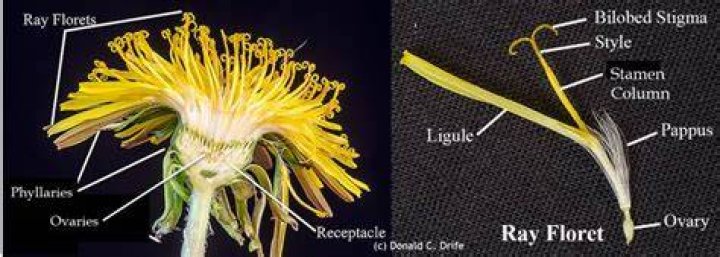
Attached to each seed is a long, thin stem that leads to a fuzzy-looking parachute structure at the end, which is called a pappus. The pappus is formed as each individual floret from the original flower dries up, leaving the center stem and the residual piece of fluff at the end.
What are dandelion feathers called?
The parachute is a bunch of bristles called a pappus. Each pappus carries around 100 filaments, each attached to a central point, rather like the head of a chimney sweep's brush.
What are the parts of a dandelion?
Indeed, all parts of dandelions are edible: leaves, flowers and roots. Dandelions are a good source of vitamin A, vitamin C, vitamin K, and vitamin D, along with calcium, iron, magnesium, and potassium. Traditionally, dandelions were used to treat diseases of the kidney, liver, joints and gallbladder.
What are the white part of dandelions called?
As you saw in the timelapse, once the flower head has matured, it closes up and the withered flowers contract into a bud-like shape and fall away, leaving just the tufty white parts called pappi, which will help wind disperse the dandelion fruits or cypsela.
What are the fuzzy ends of a dandelion called?
What is dandelion fluff used for?
They can help detoxify the liver, gallbladder, and kidneys. Other dandelion uses are to treat urinary infections, gout, diabetes, and even prostate enlargement.
Are dandelion leaves fuzzy?
Even though all three have similarly shaped coarsely toothed leaves forming rosettes at the plant's base, ONLY Cat's Ear has leaves covered with stiff hairs. These fuzzy leaves are responsible for its common name, and it has other common names including Hairy Dandelion.
Why do dandelion seeds have fluffy tops?
Dandelion Seed
The white tuft at the top of each stem acts as a parachute enabling the seed to travel on the breeze or be picked up when brushed by a passing animal or person, thereby reproducing the dandelion. It is this distinct fluffy sphere of the dandelion which enables it to reproduce.
Where is the stamen on a dandelion?
Inside the petals are the stamens, the pollen-bearing (male) parts, made up of a stalk (filament) tipped with a capsule called the anther, in which the pollen develops. The innermost part of the flower is the vase-shaped pistil, the seed-bearing (female) structure.
What are the fluffy weeds called?
They're called “dandelions,” which comes from the French words for “lion's tooth.” They're bright and friendly-looking, but grown-ups can't stand them. Dandelions are weeds, meaning they suck up more than their share of water and vitamins from the dirt.
What are dandelion plumes?
Each dandelion seed is attached to a bundle of roughly 100 feathery bristles known as a pappus, whose name derives from an ancient Greek word for grandfather due to its resemblance to a beard.
What are the fluffy flowers called?
Dandelions are popular with beekeepers as they are an early source of nectar. There are a number of folklore beliefs mostly related to the white globe of fluffy pappus in the seedhead.
Which part of dandelion can I eat?
The dandelion (Taraxacum officinale) is an abundant “weed” plant that also happens to be edible. In fact, nearly the entire plant can be consumed in one way or another. The only inedible part is the stem, which contains a very bitter, milky substance.
What is the white stuff that comes out of weeds?
White mold, also known as powdery mildew, is a fungal disease that affects various plants and vegetation.
Is there a dandelion Emoji?
The Blossom emoji symbolizes a stage of development in the life of a flower, when a flower is fully bloomed, ready to spread beauty and joy wherever it may go. However, it is sometimes also called the jasmine emoji, daffodil emoji, or dandelion emoji.
Do dandelions have bracts?
Macro photo of dandelion seed dispersal. The flower head is surrounded by bracts (sometimes mistakenly called sepals) in two series. The inner bracts are erect until the seeds mature, then flex down to allow the seeds to disperse; the outer bracts are always reflexed downward.
What part of the dandelion is used for tea?
You can make dandelion tea from the leaves, flowers, or roots of the plants, with the latter being the most common method. Herbal tea made with the flowers tends to be more delicate and sweet than those made with the roots or leaves.
What are parts of flowers?
Parts of a Flower
- Peduncle: The stalk of a flower.
- Receptacle: The part of a flower stalk where the parts of the flower are attached.
- Sepal: The outer parts of the flower (often green and leaf-like) that enclose a developing bud.
- Petal: The parts of a flower that are often conspicuously colored.
What do kids call dandelion seeds?
Eventually, all those beautiful flowers eventually turn to white globes of exposed seeds that are often called "puffballs." Dandelions grow so successfully because those puffballs disperse their seeds over long distances in a stiff breeze.
Are dandelions edible raw?
Dandelion leaves to be eaten raw are best when they are fresh and young. As they age, the leaves get increasingly bitter. But they are still edible, particularly if you blanch them before using them in your recipe.
Can you eat fuzzy dandelion greens?
Look for very fuzzy leaves and multiple dandelion-like flowers/fuzzballs on common catsear, compared to smooth leaves and single flower heads on each stem for dandelion. Yes, like the dandelion it is edible.
Are dandelion stems fuzzy?
The leaves of the common catsear are more lobed than pointy and they're furry, while dandelions' are smooth. Both leaves are edible, prepared in salads or sautéed. One other way to tell them apart is that each stem of catsears branches into multiple blooms, while dandelions have only one bloom per stem.
Do dandelions have hairy stems?
Most striking are the bright yellow flowers that are borne on the ends of long stems. Common dandelion plants can be distinguished because young leaves do not have hairs, whereas cat's ear dandelion leaves have dense hairs.
Can you eat dandelion puffs?
Dandelions are noted for their ability to stabilize blood sugar, making them an excellent supplement for diabetics. Plus, you can eat the flower too. In fact, every part of this little cheerful plant is edible! There are so many other ways people have used these little plants.